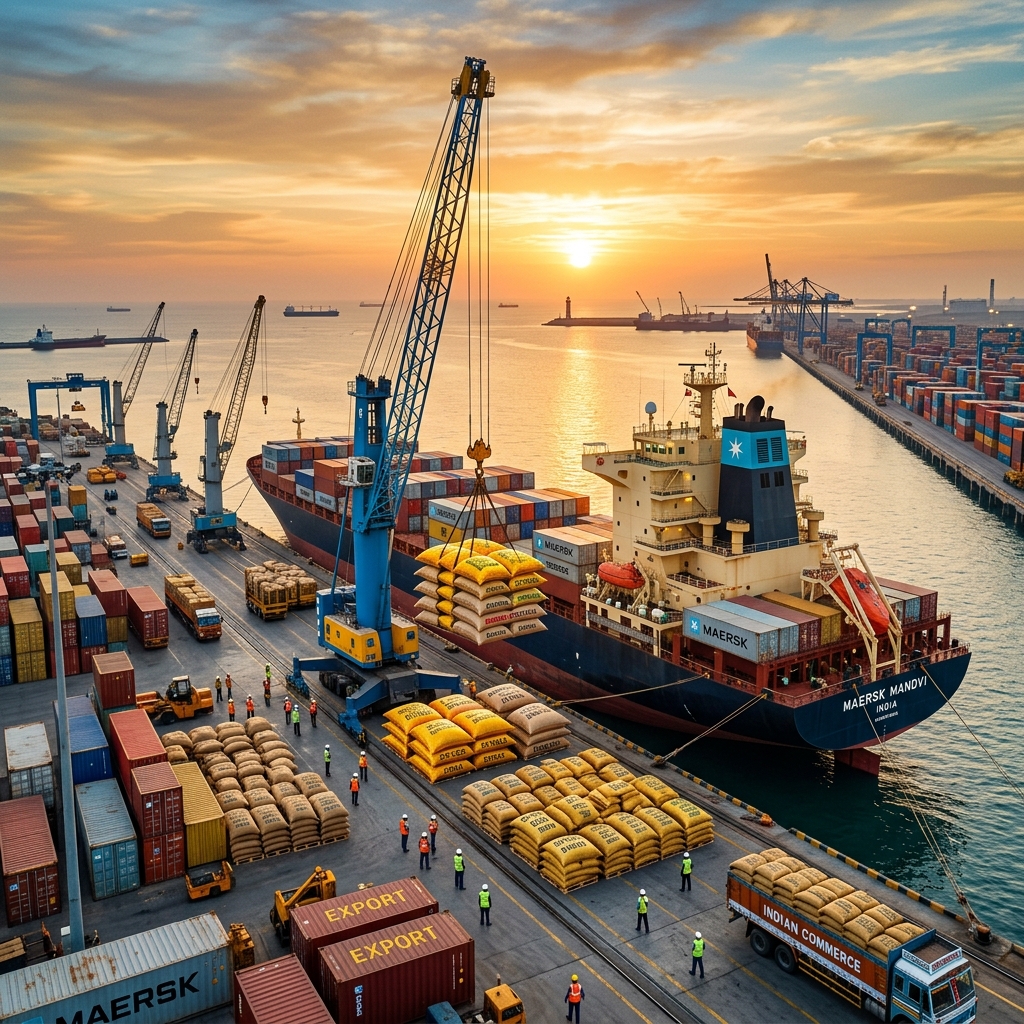
India has long been known as the world's spice basket, a leading pulses exporter, and a major supplier of basmati rice to global markets. Yet for many businesses and entrepreneurs, the mechanics of actually moving goods across borders — compliantly, profitably, and at scale — remain intimidating. This guide, drawn from the 35-year trading experience of Kings Nayraa Global, breaks it down clearly.
India's Position in Global Agro Trade
India is the world's largest producer of pulses, accounting for over 25% of global production. It is also among the top 3 exporters of rice, spices, and oilseeds. The country's diverse agro-climatic zones produce an extraordinary range of commodities — from the Alphonso mangoes of the Konkan coast to the long-grain basmati of Punjab and Haryana, from the fiery Guntur chillies of Andhra Pradesh to the premium cumin of Rajasthan.
For international buyers — whether they are food processors in the UK, commodity traders in Dubai, or restaurant chains in the USA — India offers an unmatched combination of quality, variety, and price competitiveness. For Indian exporters, the opportunity has never been larger.
What Does an Export House Actually Do?
Kings Nayraa Global holds the status of a recognised Export House — a designation awarded by India's Directorate General of Foreign Trade (DGFT) to exporters who demonstrate consistent export performance and credibility. This status unlocks several strategic advantages:
- Priority treatment in government schemes and APEDA (Agricultural and Processed Food Products Export Development Authority) programmes
- Faster customs clearance and simplified documentation
- Access to Duty Drawback and RODTEP (Remission of Duties and Taxes on Exported Products) incentives
- Enhanced credibility with international buyers who seek verified Indian exporters
- Ability to issue GSP (Generalised System of Preferences) certificates for preferential duty treatment in importing countries
Our Core Export Categories
Pulses — India's Protein Powerhouse
Toor dal, masoor dal, chana dal, urad dal, green moong, and white chickpeas form the backbone of Indian pulse exports. India supplies over 60% of the world's toor dal requirements. Key markets include the UK, USA, Middle East, East Africa, and South Asia. Kings Nayraa Global sources from APEDA-certified farms and processing units to guarantee grading, moisture levels, and aflatoxin compliance for every shipment.
Spices — The Original Global Trade Commodity
India accounts for 75% of global spice production. Our export range covers turmeric, cumin, coriander, black pepper, cardamom, chillies, and fenugreek. Each spice is tested for pesticide residues, heavy metals, and microbial counts to comply with EU, USFDA, and GCC import regulations — the three most demanding regulatory environments in the world.
Basmati & Non-Basmati Rice
Indian basmati rice — particularly from the Punjab, Haryana, and Uttarakhand GI zones — commands a global premium. Our basmati exports go primarily to the Middle East, where it is a daily staple, and to the UK and North America, where Indian diaspora communities drive consistent demand. Non-basmati parboiled rice is our primary supply to African markets.
Oilseeds & Other Commodities
Groundnuts, sesame seeds, and castor oil are India's leading oilseed exports. We also handle wheat, sorghum, and selected textile commodities depending on seasonal availability and buyer requirements.
Navigating International Regulations
The most common reason Indian agro exporters fail internationally is not price — it is compliance. Each destination market has specific requirements:
- European Union — Strict pesticide MRL (Maximum Residue Limits) testing, often more stringent than Indian domestic standards. All consignments require phytosanitary certificates from NPPO India.
- United States (USFDA) — Prior Notice filing, FSMA (Food Safety Modernisation Act) compliance, and labelling requirements including country of origin and allergen declarations.
- Middle East & GCC — Halal certification (where applicable), Arabic language labelling, and GSO (Gulf Standards Organisation) food safety compliance.
- Australia & New Zealand — AQIS (Australian Quarantine Inspection Service) clearance, strict biosecurity rules, and FSANZ food standards compliance.
Kings Nayraa Global's 35 years of export experience means we have navigated every one of these regulatory environments and built lasting relationships with licensed customs house agents, freight forwarders, and in-country distribution partners in all major markets.
Why Partner With an Established Export House?
For international buyers, the risks of sourcing directly from small Indian traders are significant — inconsistent quality, documentation errors, shipment delays, and after-sales disputes. Partnering with a recognised Export House like Kings Nayraa Global offers:
- Consistent quality across repeat orders — backed by third-party lab testing
- Pre-shipment inspection and certificate of analysis with every consignment
- Flexible payment terms (LC, DP, TT) based on relationship history
- Full documentation support: Certificate of Origin, Phytosanitary, Fumigation, Bill of Lading, Commercial Invoice, Packing List
- Single point of contact for all communication — no middlemen
Getting Started: How to Initiate an Export Inquiry
If you are an international buyer looking to source Indian agro commodities, or an Indian business looking to understand how to enter the export market, our team is available to guide you. We accept inquiries from importers, distributors, food processors, and institutional buyers across all six continents.
Ready to Explore Export Partnerships?
Browse our full product range and download our export catalogue, or speak directly with our trade team.